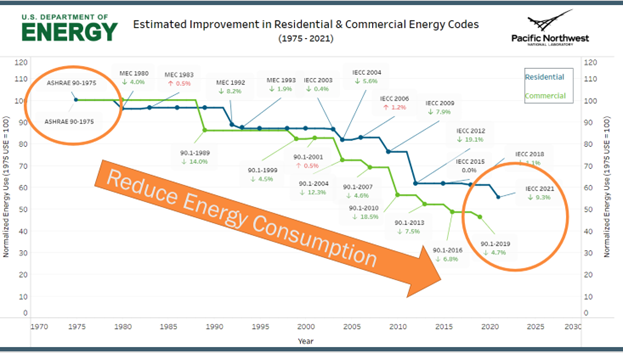
Every project that is under permit with the City will be required to identify their level of compliance or exempt status from the new energy code. Depending on the project type, one of two forms will need to be completed: COMcheck for commercial use and REScheck for residential. Both platforms have been developed by the U.S. Department of Energy with the objective of specifically demonstrating compliance with nationally recognized energy codes.
This is also a self-regulated process; the City of Chicago does not officially review for energy code compliance. Forms are kept on record and, if incorrect or incomplete, can put your project at risk for liability. Thus, an in-depth understanding of the required code is essential. Without it, your project could easily fall out of compliance and become subject to citations.
There are two different code versions. If submitting for a project based in the City of Chicago, you will need to submit based on the Illinois Energy Code. If you are submitting for a project anywhere else in Illinois, you will need to use the Illinois State version. Note: The Illinois Joint Committee on Administrative Rules (JCAR), a bipartisan legislative oversight committee that conducts reviews of administrative rules promulgated by State agencies, has received all comments on the proposed updated version of the Illinois Energy Conservation Code (also based on the 2021 IECC). JCAR has conducted a public hearing in Springfield, and the updates should be in effect by the end of this calendar year. The Illinois version will be enforceable in all communities outside of Illinois.
Some additional advancements of the new code to take note of are:
- Thermal envelope maximum requirements have increased
- New requirements for tubular daylighting devices and skylights
- Roof assembly thickness has increased, and installation is clearly indicated
- Slab on grade insulation is mandatory
- Air barrier and leakage testing is now mandatory
- Reduced interior lighting power allowances are spelled out
- Requirements for automatic turn-off or reduced lighting in unoccupied spaces
- 50% of all receptables in office areas must be controlled
- 50% of exterior lighting are to turn off after hours
- Commissioning of all systems are to be integrated, including equipment, envelope, and systems/controls
For more detailed information and parameters, check out the official Ordinance from the City of Chicago, City Council.
We know it will take some time for our design and construction partners to familiarize themselves with these new critical changes, but here at Primera, we pride ourselves in providing our clients with high-level and innovative expertise. If you are interested in obtaining more in-depth code compliance information for your current or future project, don’t hesitate to reach out to Jill Deichmann, AIA, NCARB for assistance with navigating the new code and getting up to speed.