Analyzing Primera’s Carbon Footprint: 2025 Results

April 22, 2026

Primera Engineers follows the Greenhouse Gas (GHG) Protocol, a global industry standard for reporting our carbon emissions. Primera adopted this standard in 2023 but has been tracking carbon emissions on a periodic basis since 2009. This new standard provides additional guidance on various emissions reporting areas, which are included in this report.

GHG Protocol

Before diving into the data, here is some background on the GHG Protocol. The GHG Protocol provides a carbon emissions accounting standard for various entities from corporations, government agencies, non-governmental organizations (NGOs), cities and even countries. It has been around for about 25 years and establishes a global standard for the measurement and management of greenhouse gas emissions. For our purpose at Primera, we use the GHG Protocol’s Corporate Standard.[1] The GHG Protocol categorizes emissions into three general accounting groups called Scopes which include:

  • Scope 1 – Direct Emissions/What we burn (e.g. fleet vehicle fuel usage)
  • Scope 2 – Purchased Emissions/What we buy (e.g. office electricity)
  • Scope 3 – Indirect Emissions/Everything else (e.g. consumables, business travel, commuting)

Primera continues to promote efforts that make us a greener company, not only in the services we provide but also in the way we conduct and maintain our business. This marks the seventh analysis conducted to determine our company’s current carbon footprint position, allowing us to manage emissions going forward. Primera’s initial analysis was conducted for the 2009 calendar year and included data from Primera’s only office at the time, our Chicago headquarters location. As of 2025, Primera now has offices in Colorado, Georgia, Illinois, Indiana, Texas, and Pennsylvania, which are reflected in this year’s data. Another major difference from Primera’s original analysis is the shift to working from home. Compared to pre-2020 reporting periods, the jump to remote work is significant, now with about a third of Primera employees working exclusively remote in 2025.
[1] GHG Source

Primera's 2025 Results

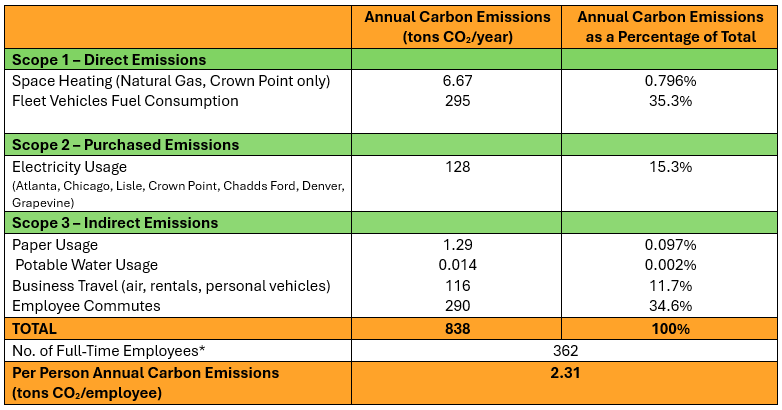
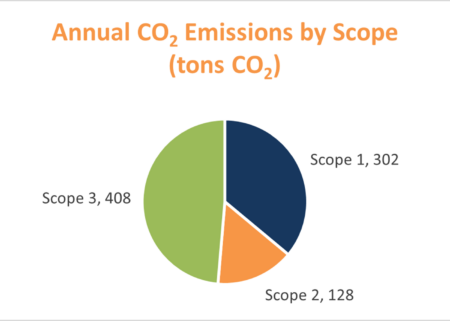
Now let’s take a look at Primera’s carbon footprint results. The following data was collected from the 2025 calendar year. Using our utility bills, fleet gasoline purchases, business travel mileage, restroom usage estimates, and office paper orders, which include all printers, copiers, and plotters, we estimated the consumption of electricity, fuel, water, and paper. To estimate the carbon emissions from our commutes, we surveyed all our employees’ commuting habits and calculated carbon emissions based on the mode of travel. Based on this data, we found that our annual carbon emissions by source for 2025 are as follows:


Since we began tracking Primera’s emissions, our commuting habits have always been the largest source of CO2 emissions. This year however, fleet vehicle emissions have surpassed commuting emissions, making it the company’s largest emission source at 295 tons for 2025 – a 51% increase from the last reporting period in 2023. This spike is mainly due to the growth of our Construction division and the need for in-the-field personnel using company vehicles. Employee commutes still accounted for 290 tons in 2025, a very close second, followed by emissions from our office electricity usage. These top three emission sources account for 714 tons, or 85%, of our total CO2 emissions. Paper and potable water use continue to have an almost insignificant impact and continue to trend downward. However, business travel emissions are increasing since Primera began measuring them in 2023.

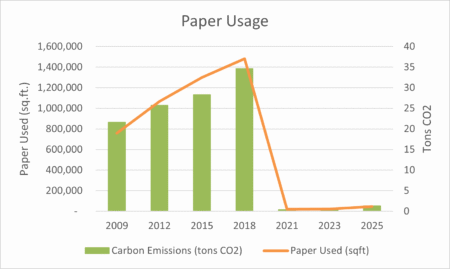
Although paper usage is a very small percentage of the total, this source of emissions has seen the largest decrease since Primera began tracking this data. While a significant portion of the decrease can be attributed to more work from home opportunities, Primera made a concerted effort before the pandemic to move to digital platforms in order to reduce paper usage in the office. The combination of fewer in person meetings, default double-sided printer settings, online reviews, and electronic document control platforms has reduced emissions due to paper usage by 96% since 2018, an annual reduction of 33.3 tons or 1.4 million square feet of paper.

Because a large portion of Primera’s work force has switched to hybrid or remote work, our commuting emissions have significantly lowered since 2018. Even with a 71% increase in the number of employees over this period, our absolute carbon emissions from commuting decreased by 34%. Primera’s total carbon emissions for 2025 were 838 tons CO2. This translates to about 2.31 tons CO2 per employee in 2025. To put this into perspective, in 2018 (the last pre-pandemic reporting year), the results were 801 tons CO2 and 3.78 tons per employee. Retrospectively, this data shows a 39% decrease per employee despite a slight increase in CO2 emissions in absolute terms.

What it All Means

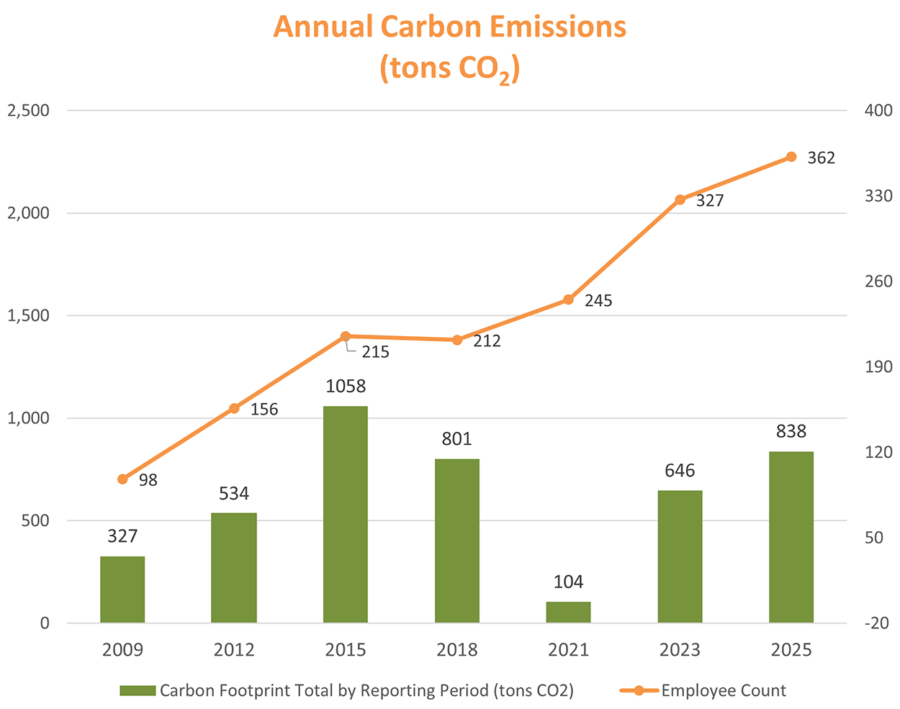
As shown on the figure below, the 2021 reporting period presents itself as an outlier, but it shows as the inflection point in the new reality since the pandemic. The biggest takeaway from the 2025 data is that working from home has significantly reduced our company’s overall carbon footprint and, although commuting is now the second largest source of emissions after our fleet vehicles, it still accounts for more than a third of the total emissions. Primera’s historical emissions are shown below, along with the growth of the company by number of employees:


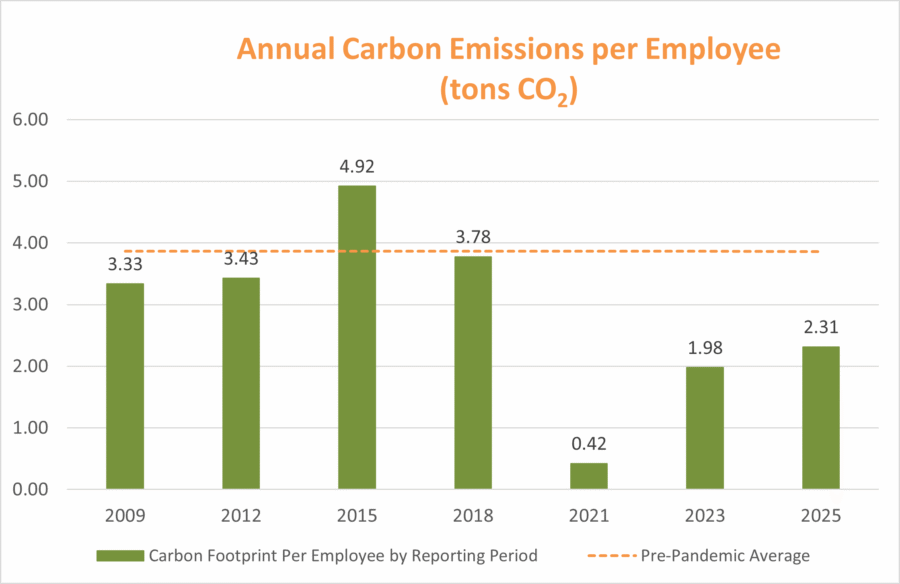
To normalize this data, we analyzed our carbon footprint on a per employee basis. Below is the historical data for Primera showing the annual carbon emissions per employee for each of the reporting periods:


Using a per employee carbon footprint helps eliminate some of the variability due to the changing number of employees at any given office for any given year. Primera’s average pre-pandemic carbon emissions by employee was 3.86 tons CO2. That number dropped to 0.42 tons CO2 in 2021 but only rebounded to 2.31 tons CO2 last year, about 60% of the pre-pandemic average.

The new hybrid and remote working reality of today has given Primera a boost in the right direction by significantly lowering our commuting emissions. While we will never eliminate our commuting emissions completely, we should continue to be mindful of what modes we use to commute. Primera encourages employees to take advantage of mass transit systems, walk/bike when they can, and take advantage of remote working tools, such as Teams meetings, when possible. Primera even provides mass transit subsidies to employees and the opportunity to buy transit tickets on a pre-tax basis. Even at our offices that are not well-served by public transit, we hope that alternative methods, such as carpooling, can be used when possible.

Fun Facts & Key Takeaways

In 2025:

  • Primera employees commuted, on average, 26,970 miles per week.
  • Walking and biking, the only carbon-free modes of transportation, accounted for 384 miles per week of the total average weekly commute.
  • Primera used enough paper, 1.04 acres, to cover Enpower Field, the Denver Broncos Stadium, from goal line to goal line.
  • Our CO2 emissions are equivalent to driving a gasoline-powered car to the moon and back four and a half times! That’s 2.1 million miles.
  • It would take 763 acres of forest to sequester all the CO2 Primera emitted.

Contact us to learn more.

We’re excited to meet you. Complete this simple form to connect with us today.

Chicago (Headquarters)
(312) 606-0910 View All Locations

"*" indicates required fields

This field is for validation purposes and should be left unchanged.