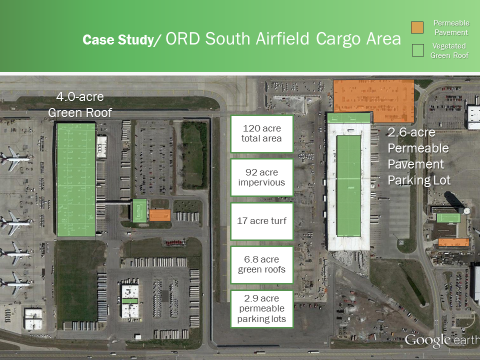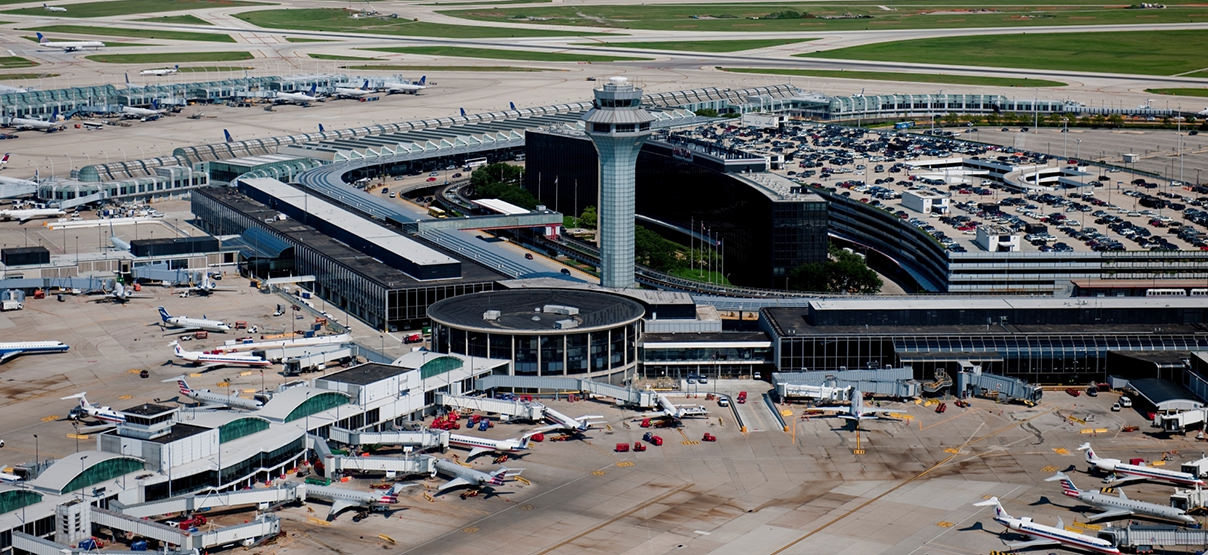
Now imagine the use of these techniques being wedged between two active runways in the commercial face of an airport (versus the public passenger-facing side) – this is what Chicago O’Hare Airport’s South Cargo Area looks like. As part of the Master Civil Engineer group for the O’Hare Modernization Program (OMP), Primera Engineers has served as the key reviewer for the Chicago Department of Aviation’s (CDA) sustainability requirements for all airport projects, including those in this stormwater management case study.
Stormwater management is a major concern at O’Hare, as it is for any airport. The vast areas of impermeable pavement and roof surfaces – over 2,300 acres total in O’Hare’s case – create huge volumes of stormwater runoff that lead to storm sewer systems on the airfield. This runoff is ultimately discharged to the Metropolitan Water Reclamation District (MWRD) for treatment because, for most of the year, the runoff is contaminated by aircraft deicing fluid and cannot be discharged to local receiving streams. Since the stormwater is sent to MWRD for treatment, the CDA must pay millions of dollars in fees to treat this stormwater annually.
When considering green stormwater techniques in any project, one must first consider the environment for which they will be set. Since an airport setting is so unique, engineers had to address some of these technologies with a little more scrutiny. For example, infiltration systems are usually encouraged, especially in the case of permeable pavement, but in an airport they would not make sense where the runoff is contaminated with deicing fluid that must be sent for treatment. As a result, permeable pavement only makes sense in non-aircraft movement areas. Another example is the use of native vegetation to promote infiltration or for green roof applications. At an airport, however, this can be problematic because certain native vegetation attracts wildlife which creates safety issues for aircraft. Due to this concern, the OMP developed a special landscaping specification which includes species of plants that are acceptable and those which are explicitly banned. With the approval of the United States Department of Agriculture (USDA), specific plants were chosen to minimize wildlife attraction, which were also low-maintenance and drought tolerant. Although there was initial skepticism on the use of green stormwater techniques at an airport, Primera, with the help of the various airport stakeholders, was able to find ways to address many of the concerns.
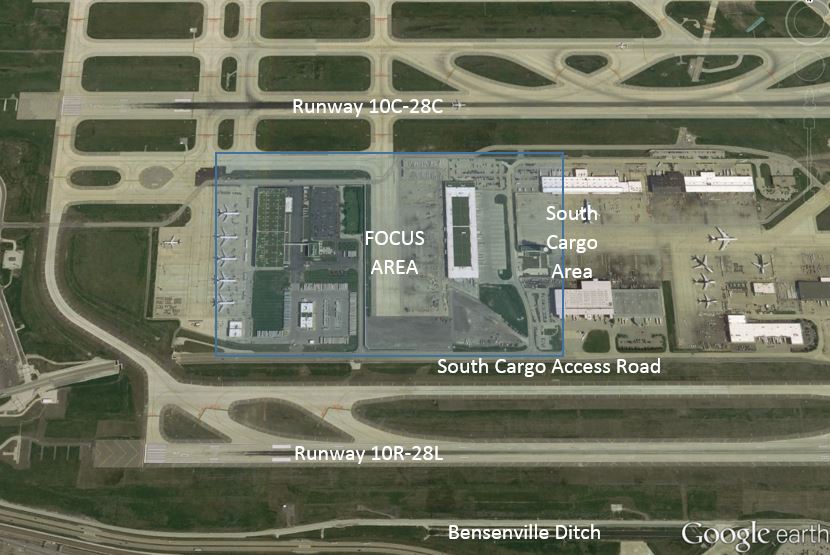
The study area that we are focusing on for the purpose of this article is a 120-acre area on the western end of the South Cargo Area that is shown in the picture below: